
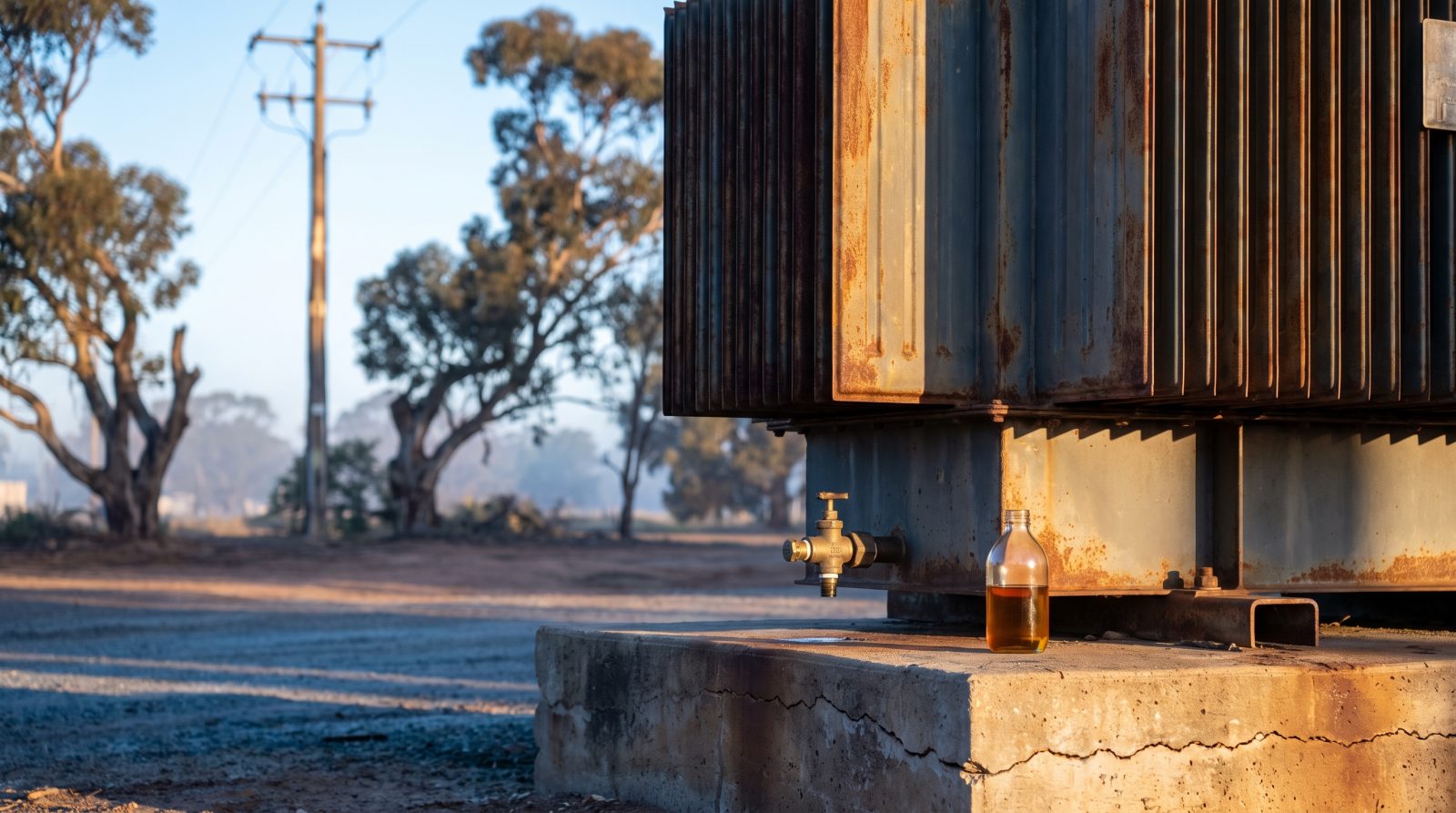
This guide is for electrical asset managers, decommissioning contractors and environmental managers in Australia who need to test transformer oil for PCBs (polychlorinated biphenyls) before a unit is drained, scrapped or sold. The short answer: take a representative oil sample, send it to a laboratory accredited by the National Association of Testing Authorities (NATA) for gas chromatography to IEC 61619, and read the result against the two levels regulators use, 2 mg/kg and 50 mg/kg. The result decides whether the oil can go to used oil recovery or must be managed as PCB waste.
Key takeaways
- In New South Wales, oil containing PCBs above 2 mg/kg is PCB material, and oil at 50 mg/kg or more holding 50 grams or more of PCBs is scheduled PCB material, under the PCB Chemical Control Order 1997.
- A nameplate alone does not prove a transformer is PCB-free: older units can be cross-contaminated from earlier top-ups, servicing or retrofills (draining the original fluid and refilling with a different one).
- Laboratories measure PCB concentration in insulating oil by capillary column gas chromatography, the method described in IEC 61619:1997.
- The Stockholm Convention asks parties to make determined efforts to identify, label and remove PCB-containing equipment from use by 2025, and to manage the liquids and equipment as PCB waste no later than 2028.
- Diluting PCB oil to bring it under a threshold is prohibited under the NSW order.
Why test transformer oil for PCBs before scrapping?
Because the PCB result determines the disposal route, the paperwork and the cost of what follows. PCBs are synthetic chlorinated compounds once used as insulating fluids in transformers and capacitors, and they are listed under the Stockholm Convention on Persistent Organic Pollutants.
A transformer built after PCB fluids were withdrawn can still test positive through a contaminated top-up, a retrofill without a full flush, or shared workshop hoses. Scrapping without a test risks sending PCB oil into a used transformer oil recovery stream, contaminating a much larger volume and leaving the generating site exposed.
What concentration makes oil PCB-contaminated or scheduled waste?
Oil above 2 mg/kg is PCB material, and oil at 50 mg/kg or more holding 50 grams or more of PCBs is scheduled PCB material, under the NSW Polychlorinated Biphenyl (PCB) Chemical Control Order 1997.
- Above 2 mg/kg: the oil, the equipment and any waste from it count as PCB material or PCB waste. It cannot be treated as ordinary used oil.
- Above 2 mg/kg and below 50 mg/kg: non-scheduled PCB material, which still needs managed disposal under lighter conditions.
- 50 mg/kg or more, with 50 grams or more of PCBs in aggregate: scheduled PCB material or scheduled PCB waste, which attracts the strictest storage, notification and processing conditions.
A milligram per kilogram (mg/kg) is one part per million by mass. Other states and territories set their own definitions and notification triggers, so confirm the rules with the regulator in the state where the transformer sits.
How do you take an oil sample from a transformer?
Draw the sample from the transformer's sampling valve into a laboratory-supplied glass container, after flushing the valve, and record it on a chain of custody form (a record of who held the sample, and when, from the valve to the laboratory). The sample must represent the oil in the tank rather than the sludge at the drain valve. The steps below describe common practice; the laboratory's instructions and the site's electrical and safety procedures take precedence.
Sampling checklist
- Identify the transformer: serial number, manufacturer, year, oil volume and service history. Treat the nameplate and any earlier PCB label as a starting point, not the answer.
- Draw the sample from the sampling or drain valve after flushing the first portion into a container (it is potential PCB waste), so sediment in the valve does not dominate the sample.
- Use a clean, labelled glass container approved by the laboratory and seal it immediately.
- Record the date, time, sampling point, sampler and transformer on the chain of custody form.
Sample each unit before it is drained, scrapped or sold: one result does not clear another transformer.
What laboratory method and certificate should you expect?
The method
Laboratories carry out PCB testing of transformer oil by high-resolution capillary column gas chromatography with an electron capture detector (a detector that responds strongly to chlorinated compounds), the method set out in IEC 61619:1997, Insulating liquids - Contamination by polychlorinated biphenyls (PCBs) - Method of determination by capillary column gas chromatography. The method is written for non-halogenated insulating liquids and reports total PCB content.
What the certificate should state
A useful certificate of analysis states the laboratory and its NATA accreditation, the method, the sample identity and date received, the reporting limit (the lowest concentration the laboratory will report as a number), and the result in mg/kg. A result below the reporting limit only means something if that limit sits below 2 mg/kg. Keep the certificate with the transformer records.
What happens after the result?
The result places the oil on one of three paths.
| Result | Classification (NSW order) | Typical pathway |
|---|---|---|
| 2 mg/kg or below | Not PCB material | Used transformer oil recovery, reuse or regeneration |
| Above 2 mg/kg and below 50 mg/kg | Non-scheduled PCB material | Managed collection and treatment by an EPA-approved process |
| 50 mg/kg or more (50 g or more of PCBs) | Scheduled PCB material | Notification, marked packaging, AS 1940 storage, licensed treatment |
Scheduled material brings extra duties
Under the NSW order, an occupier holding more than 10 kg of scheduled PCB material or waste must notify the EPA in writing within 30 days and then annually. Every package must be clearly marked and kept in good order. Liquid scheduled material must be stored in line with AS 1940, the Australian Standard for the storage and handling of flammable and combustible liquids. One tonne or more of scheduled PCB waste must be kept under a licence.
Dilution is not an option
The NSW order lists dilution of PCB material, and splitting scheduled material so that it becomes non-scheduled, as prohibited activities.
What do the Stockholm Convention dates mean for equipment still in service?
For a transformer still in service, the dates mean it should be tested, labelled if positive, and scheduled for replacement and disposal rather than left until it fails. The Stockholm Convention lists PCBs in Annex A (chemicals to be eliminated) and Annex C (chemicals produced unintentionally). Parties ban the production and new uses of PCBs, make determined efforts to identify, label and remove from use equipment containing PCBs by 2025, and work towards environmentally sound waste management of PCB liquids and contaminated equipment as soon as possible and no later than 2028. These are best-efforts obligations, not a date on which equipment is banned.
Frequently asked questions
Can I tell from the nameplate whether a transformer has PCBs?
No. A nameplate shows the fluid the transformer was built with, not what was added later. Only a laboratory test confirms the PCB concentration.
Is oil below 2 mg/kg safe to send for used oil recovery?
Under the NSW order, oil at or below 2 mg/kg is not PCB material and can follow normal used transformer oil recovery. Send the certificate of analysis with the consignment.
What if the result is between 2 and 50 mg/kg?
The oil is non-scheduled PCB material. In NSW it must be treated by a process approved in writing by the EPA, without the notification and licensing duties that apply to scheduled material. It cannot be diluted to get below 2 mg/kg.
Sources
- Polychlorinated Biphenyl (PCB) Chemical Control Order 1997, NSW Environment Protection Authority, gazetted 20 June 1997, commenced 21 July 1997.
- IEC 61619:1997, Insulating liquids - Contamination by polychlorinated biphenyls (PCBs) - Method of determination by capillary column gas chromatography, International Electrotechnical Commission, 1997.
- PCBs overview, Secretariat of the Basel, Rotterdam and Stockholm Conventions, accessed 13 October 2026.
How Benzoil can help
Benzoil arranges PCB sampling and NATA-accredited testing of transformer oil through its licensed partner network, then organises the pathway the result calls for, from used oil recovery to PCB oil disposal and transformer decommissioning. See PCB oil disposal and transformer oil recycling, or our guides on PCB oil disposal and transformer decontamination and scrapping high voltage equipment. To talk through a transformer or a fleet, call 0497 645 008, email info@benzoil.com.au, request a quote or contact us.


