
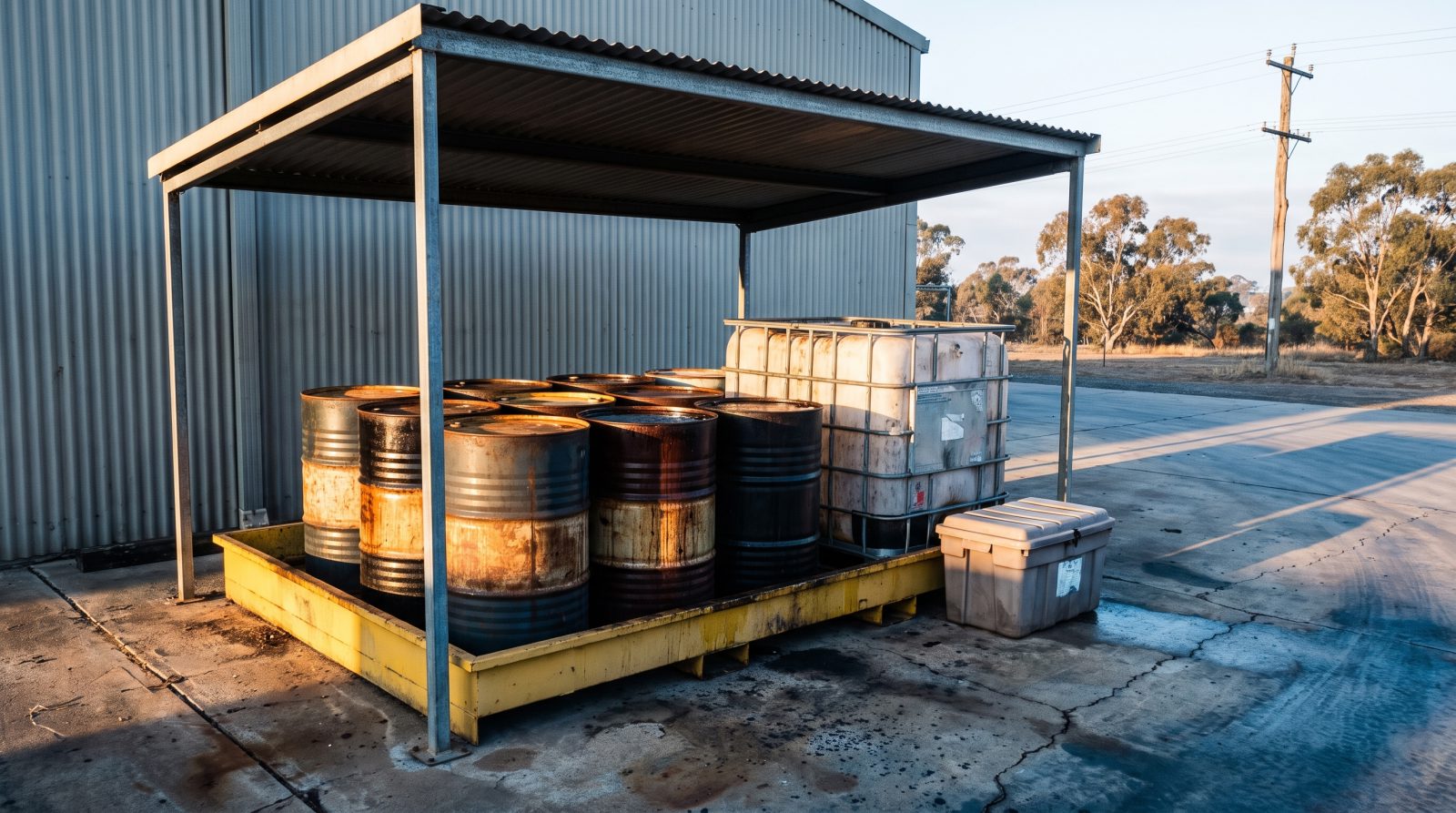
This guide is for plant managers, workshop supervisors, fleet operators and environmental managers in Australia who hold used oil on site and need it collected. The short answer: store waste oil in sound, labelled containers inside a bunded and covered area, and keep the different oil streams apart. Hold the paperwork that shows where the oil came from, and arrange waste oil collection through a service that uses licensed transporters and delivers to a facility authorised to receive it.
Key takeaways
- The NSW regulator's fact sheet asks for bunds holding at least 100 per cent of the largest tank, or 25 per cent of the total volume when oil is held in drums.
- The same fact sheet asks for every drum and storage vessel to be labelled with its contents, and WorkSafe Victoria says a drum holding dangerous goods residue keeps its hazard labelling until it is cleaned.
- Engine and hydraulic oil, transformer oil, synthetic oil, coolant and fuel are worth more and cost less to dispose of when kept separate.
- In Victoria, whoever manages or controls industrial waste must classify it, both the transporter and the person who permits the transport carry duties, and the waste must go to a lawful place.
- Benzoil arranges waste oil collection for businesses across Australia through licensed partners, from a few drums to bulk tanker loads, with disposal certificates where needed.
What counts as waste oil for collection?
Waste oil, also called used oil, is any petroleum or synthetic oil that can no longer do its job because it is contaminated or has lost its properties in service. On Australian sites it includes used engine and gearbox oil, hydraulic oil, compressor oil, metalworking oils and insulating oil drained from transformers. Used oil is a combustible liquid rather than a flammable one, but it becomes an industrial waste once it leaves the machine, so its storage, transport and disposal are all regulated. How used oil is valued depends heavily on how well those rules are followed on site.
How should waste oil be stored before collection?
Store it in sound containers, inside a bund (a raised, impermeable wall or tray that holds any spill), under a roof, with a label on every vessel. The Storing liquid waste fact sheet from the NSW Department of Environment and Conservation (October 2005), still published by the NSW EPA, sets out the practical rules:
- Size bunds to hold at least 100 per cent of the volume of the largest tank; where waste is held in drums or other small containers, the bunded area should hold at least 25 per cent of the total volume stored.
- Roof the area so rain does not fill the bund, and do not fit drain valves; bund water is contained and tested first.
- Label every drum and storage vessel so the contents are identified.
- Do not use rusted or dented drums, and do not stack drums above the bund wall.
AS 1940:2017, The storage and handling of flammable and combustible liquids, is the Australian Standard that specifies requirements for storing and handling these liquids. WorkSafe Victoria's guidance on repairing, repurposing and disposing of tanks and drums adds that a drum not yet cleaned of dangerous goods must keep the labelling that identifies the residual hazard.
Waste oil storage checklist before you book a collection
- Containers are sound, closed and labelled with contents and start date.
- Containers sit inside a correctly sized bund, under cover, on a sealed surface.
- A spill kit and the safety data sheet are within reach.
- Streams are kept separate and nothing has been added to the oil.
- Truck and hose access has been checked.
- You know the approximate volume, the source equipment and any suspected contaminants.
Which oils must be kept separate?
Keep each stream in its own container, because mixed oil is treated as its lowest-value component.
| Stream | Keep separate from | Why |
|---|---|---|
| Used engine, gearbox and hydraulic oil | Fuel, solvents, coolant, water | The core re-refining feedstock; contamination lowers its value |
| Used transformer oil | All other oils until its PCB (polychlorinated biphenyl) status is confirmed by testing | Mixing untested oil can turn a whole tank into PCB waste |
| Used synthetic oil | Mineral oils | Synthetics have their own recovery routes and are worth more unmixed |
| Coolant and glycol | Every oil stream | Glycol is water soluble and needs a different recycling process |
| Waste petrol and other flammable liquids | Every oil stream | Flammable liquids cannot go through standard waste oil collection |
What are the legal duties when waste oil leaves your site?
Classify the waste, use a transporter and a receiving site that are allowed to take it, and keep the records: the producer stays responsible after the truck leaves. Under the Environment Protection Act 2017 and the Environment Protection Regulations 2021, EPA Victoria's industrial waste duties require anyone who manages or controls industrial waste to classify it and meet the duties that follow. Waste is sorted into industrial, priority and reportable priority waste, with duties that accumulate with the risk. Both the transporter and the person who permits the transport have duties, and the waste must go to a place authorised to receive it, which EPA Victoria calls a lawful place. Elsewhere in Australia, check the equivalent rules and the waste code for your stream with your own state regulator, ask the collector for evidence that the transporter and receiving facility may take it, and keep the transport record and certificate of disposal with your site records.
What happens after waste oil collection?
Collected oil is sampled, tested and sorted. Clean mineral oil goes to re-refining, which produces base oil for new lubricants, or to treatment that produces burner fuel. Australia supports this through the Product Stewardship for Oil scheme. Under the Product Stewardship (Oil) Regulations 2022 (compilation in force from 1 July 2023), the Commonwealth pays recyclers 50 cents a litre for re-refined base oil for use as a lubricant or a hydraulic or transformer oil that meets the criteria in Schedule 1. Other recycled oil products attract lower rates. The full process of oil recycling is covered in an earlier Benzoil article.
Frequently asked questions
How long can waste oil be stored on site before collection?
The sources above set storage conditions rather than a time limit. The practical limits are the capacity of your bunded area and the condition of the containers. Booking a collection well before the bund is full avoids an overflow.
Can waste oil be stored in the original new-oil drums?
Yes, provided the drum is sound and sealed. The NSW fact sheet asks for every vessel to be labelled with its contents, so cross out the product label, mark the drum as waste oil with the date, and keep it inside a bund.
Does a waste oil collector pay for the oil?
Sometimes. Clean, well-segregated mineral oil in volume can have a positive value, while contaminated or mixed oil usually carries a disposal charge. Benzoil arranges testing of each stream and buys used oil where the quality and volume support it.
What records should a site keep after waste oil is collected?
Keep the transport record or waste tracking document, the weighbridge docket or volume receipt, and any certificate of disposal or laboratory report the collector provides. Together they show the oil went to an authorised facility.
Sources
- Storing liquid waste, Liquid Waste Fact Sheet, Department of Environment and Conservation NSW (hosted by the NSW EPA), October 2005.
- Understand your waste obligations and duties, EPA Victoria, accessed 7 October 2026.
- Repairing, repurposing, disposing of tanks and drums, WorkSafe Victoria, accessed 7 October 2026.
- AS 1940:2017, The storage and handling of flammable and combustible liquids, Standards Australia, 2017 (Amendment 2, 2021).
- Product Stewardship (Oil) Regulations 2022, Federal Register of Legislation, compilation in force from 1 July 2023.
How Benzoil can help
Benzoil arranges waste oil collection services for businesses across Australia, with reliable coverage in Melbourne, Sydney and Brisbane and a licensed partner network for regional sites. We coordinate transport, testing and recovery of used engine, hydraulic, transformer and synthetic oils and off-specification fuels. We also supply the disposal certificates, laboratory reports and chain-of-custody records your audits need. Tell us the site, streams, volume and storage, and we will confirm the collection plan. Call 0497 645 008, email info@benzoil.com.au, book a collection online or send a message through our contact page.


