
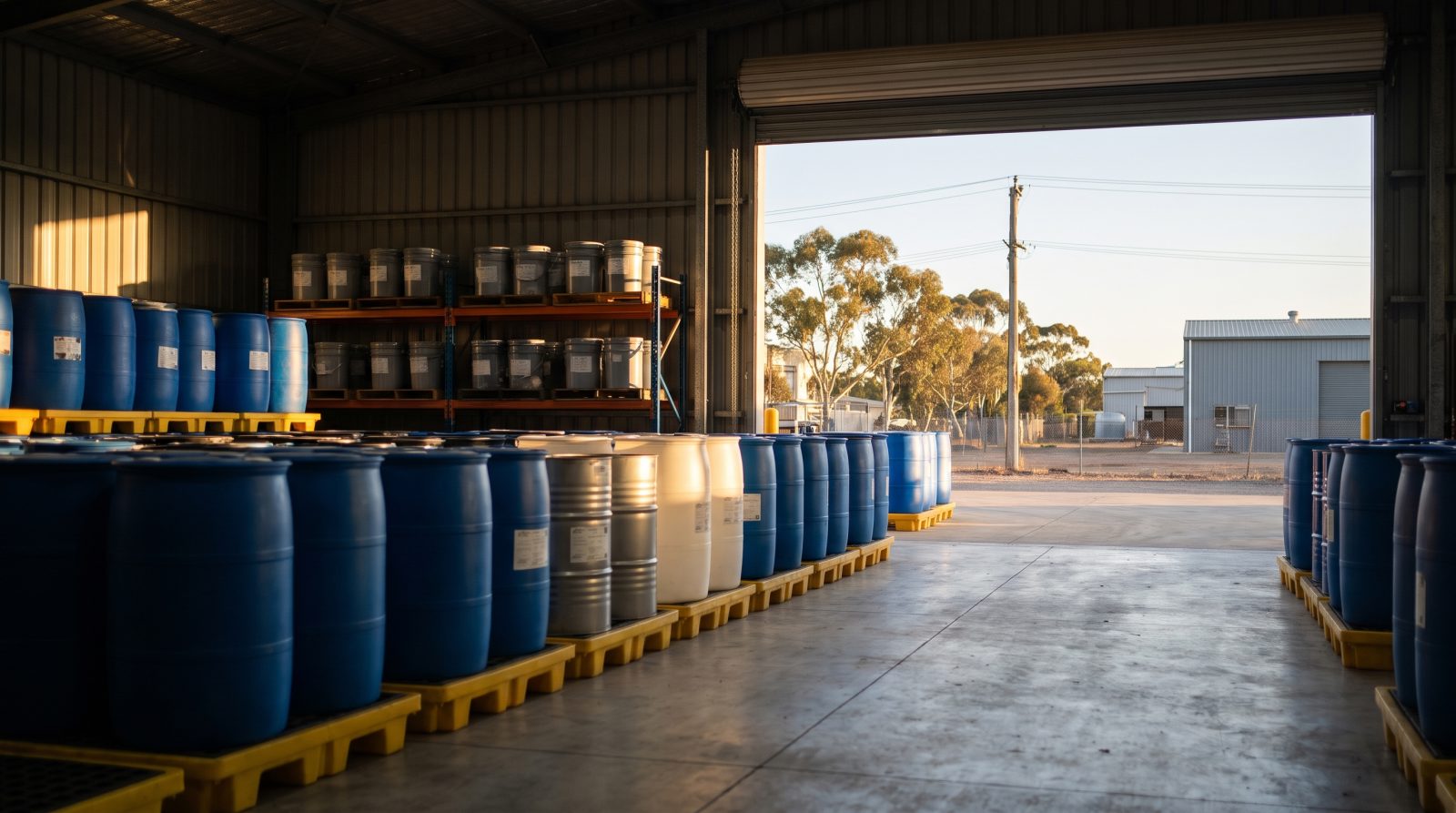
Expired chemical disposal in Australia starts with identifying exactly what you hold. Unopened stock with a current safety data sheet and known batch details can sometimes be resold. Stock that is degraded, contaminated or unidentified is usually classified and disposed of as waste. This guide is written for site, environmental and procurement managers holding expired, off-spec or surplus chemicals.
Key takeaways
- NSW and Queensland place the duty to classify waste on the business that generates it, and in Victoria anyone who manages or controls industrial waste must classify it.
- EPA Victoria lists solvents and acids among reportable priority waste, the class with the highest level of controls.
- Victorian businesses that manage priority waste must take all reasonable steps to identify and assess alternatives to disposal, including reuse and recycling.
- WorkSafe Victoria states that manufacturers and importers must review each safety data sheet at least every five years.
- Resale depends on the product still meeting a buyer's specification and on documents that show what it is.
When does surplus stock become chemical waste?
Surplus stock can become waste once it is unwanted or can no longer be used or sold for its intended purpose. From that point, state waste laws set how it must be classified, moved and treated. This guide covers Victoria, New South Wales and Queensland.
Typical triggers include stock past its shelf life, product that failed a quality check, containers with damaged labels, discontinued lines left over after a process change, and chemicals found during a site clean-up or decommissioning. Each trigger leads to a different pathway, so sort the inventory by condition before seeking quotes.
Off-spec is not the same as expired
An expiry or retest date is set by the manufacturer for the product's intended use. A chemical past that date may still meet a looser specification for another use, while a product inside its date may be off-spec because of contamination or poor storage. Only testing or the manufacturer can settle which applies.
How is chemical waste classified in each state?
Each state uses its own system, and each puts the duty to classify on the business holding the waste.
- Victoria. Anyone who manages or controls industrial waste must classify it as industrial waste, priority waste or reportable priority waste. EPA Victoria says reportable priority waste "usually poses the greatest risk to human health and the environment" and "includes solvents, acids and contaminated soils". The duties add up as the class rises.
- New South Wales. The NSW EPA requires generators to classify waste into one of six classes, including liquid waste and hazardous waste, using its Waste Classification Guidelines. Some chemicals are also covered by a chemical control order under the Environmentally Hazardous Chemicals Act 1985.
- Queensland. Under the Environmental Protection Regulation 2019, regulated waste is category 1 (highest risk) or category 2 (moderate risk). Business Queensland explains that generators either adopt the default category in Schedule 9 or have the waste sampled and tested.
Classification decides which facilities can lawfully receive the waste, whether it must be tracked, and what paperwork goes with it. Our guide to hazardous waste disposal paperwork in VIC, NSW and QLD covers the tracking step.
Can expired or surplus chemicals be resold?
Yes, if the product is still fit for a buyer's purpose and you can prove what it is. Selling usable stock keeps it out of the waste stream altogether.
Under section 140 of the Environment Protection Act 2017, EPA Victoria requires anyone who manages or controls priority waste to "take all reasonable steps to identify and assess alternatives to waste disposal", including reusing and recycling it. Checking whether surplus stock can be sold before it is declared waste is consistent with that duty.
Resale is more likely to work when:
- containers are sealed, intact and in their original packaging
- labels are legible and match the safety data sheet
- the batch or lot number is known, ideally with the original certificate of analysis
- storage has followed the manufacturer's conditions
- the volume is large enough to interest a buyer
Resale rarely works for opened part-containers, mixed or decanted product, unlabelled drums, or stock that has been stored outdoors. Benzoil's expired and excess chemicals service covers both resale and disposal.
What documents does a buyer need for surplus chemicals?
A buyer needs to know exactly what they are getting and that it can be used and stored safely. That means a current safety data sheet, batch details and evidence of quality.
WorkSafe Victoria states that manufacturers and importers must review each safety data sheet at least every five years. Downstream suppliers of dangerous goods and hazardous substances must also give safety data sheets to buyers, except retailers. Each sheet must include a date of preparation or last review and a section on disposal considerations.
Before offering stock for resale, gather:
- The current safety data sheet for each product.
- The product name, manufacturer, batch or lot number and the manufacture or expiry date.
- The certificate of analysis from the original supply, if you have it.
- The quantity, container type and size, and photos of the containers and labels.
- Storage history: indoor or outdoor, temperature, and whether containers were opened.
- Any retest results, if the product is past its retest date.
Expired chemical disposal or resale: how to decide
The condition of the stock and the quality of its records decide the pathway more than its age does.
| Situation | Likely pathway | What to provide |
|---|---|---|
| Sealed, labelled, in date | Resale | Safety data sheet, batch details, photos |
| Sealed, past retest date | Retest, then resale or disposal | Safety data sheet, batch details, test results |
| Opened, contaminated or mixed | Classified waste disposal | Safety data sheet, volume, contents description |
| Unlabelled or unknown | Identification, then disposal | Photos, location, any history |
Frequently asked questions
Who is responsible for classifying expired chemicals before disposal?
In NSW and Queensland the business that generates the waste is responsible for classifying it. In Victoria the duty applies to anyone who manages or controls industrial waste, which includes the business that produces it.
Can I sell chemicals that are past their expiry date?
Sometimes. If the product still meets a buyer's specification and you can supply a current safety data sheet and batch details, resale may be possible. Testing may be needed to confirm the product's quality.
What happens to chemicals that cannot be identified?
Unknown chemicals are difficult to sell and have to be identified before they can be classified. Sampling and analysis by a qualified person is normally the first step, followed by disposal at a facility lawfully authorised to receive that class of waste.
Is expired chemical disposal tracked in Australia?
It depends on the classification. In Victoria, reportable priority waste carries a duty to notify of transactions and a transport duty. In NSW, the EPA says waste tracking is required for some types of waste once the class is known.
Sources
- Understand your waste obligations and duties, EPA Victoria, updated 9 April 2026
- Duty to investigate alternatives to waste disposal, EPA Victoria, updated 28 October 2024
- Classifying waste, NSW EPA, updated 14 July 2021
- Regulated waste classification, Business Queensland, last reviewed 8 July 2025
- Safety data sheets, WorkSafe Victoria, reviewed 30 July 2022
How Benzoil can help
Benzoil helps businesses decide whether surplus or expired chemicals still have value. Where stock can be resold, Benzoil arranges the resale; where it cannot, Benzoil arranges disposal through licensed partners. See our expired and excess chemicals service, or read more about chemical waste disposal in Australia. Call 0497 645 008, email info@benzoil.com.au or request a quote with your inventory list and safety data sheets. You can also contact Benzoil online.


