
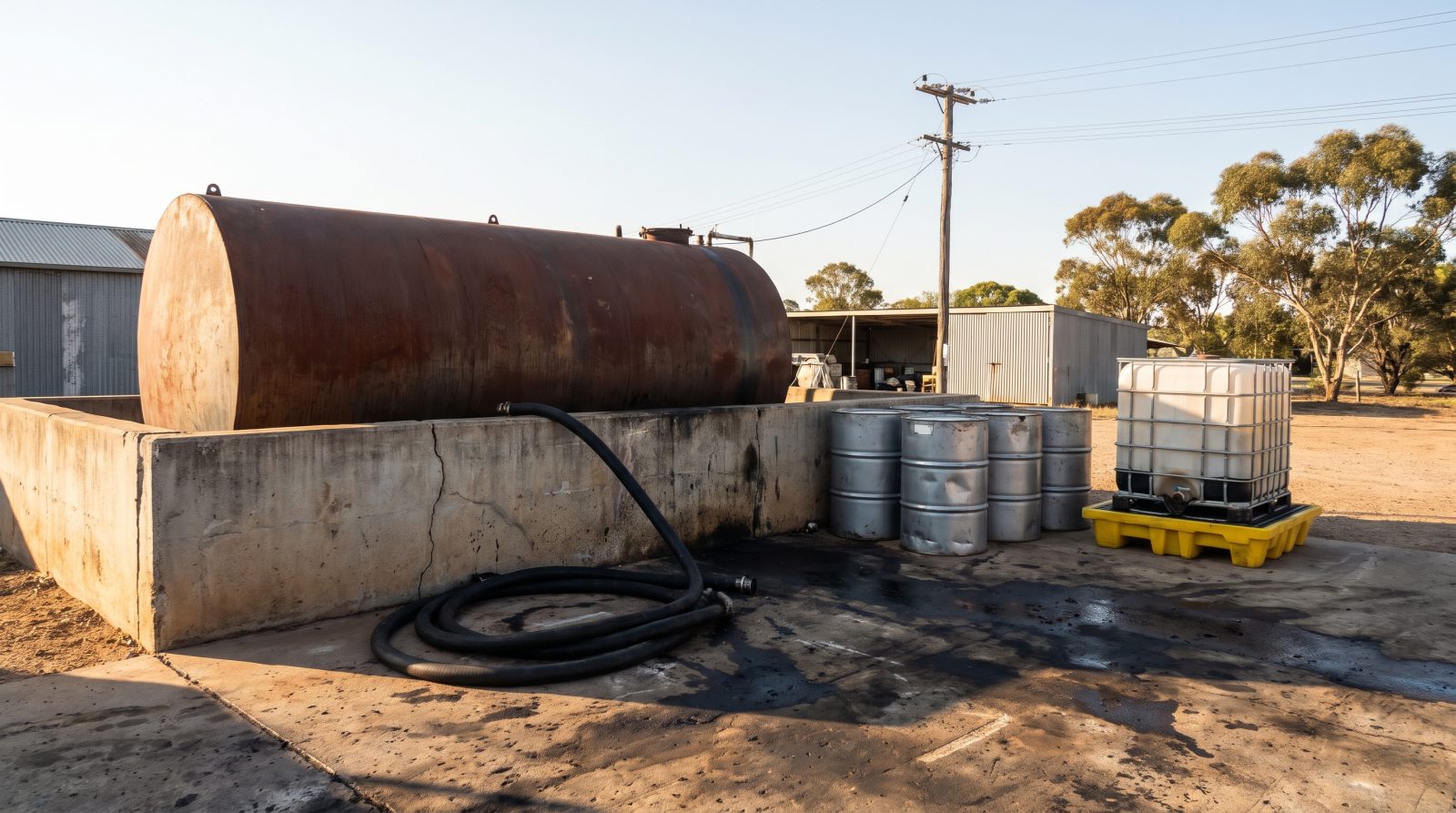
This guide is for plant, fleet and maintenance managers in Australia who need used oil taken away and want to know what it will cost. Waste oil collection is not automatically free: whether you pay or receive a payment depends on the volume, the type of oil and how clean it is. Clean oil in bulk has value to recyclers, while small lots, used engine oil and contaminated oil usually attract a collection fee.
Key takeaways
- A bulk pump-out needs about 1,000 litres on site to be worth sending a tanker.
- Below about 1,000 litres a collection usually attracts a fee rather than a rebate, and drums or IBCs from small workshops are a paid service.
- Clean used transformer oil and uncontaminated bulk lubricating oil in lots of 10,000 litres or more, with no water, solvents or PCB, are the oils most likely to earn a payment.
- The Product Stewardship for Oil scheme pays a benefit on eligible recycled oil products, which is one reason clean used oil has value.
- Each pickup comes with state waste tracking paperwork raised by the licensed transporter, and you should keep a copy.
Is waste oil collection free in Australia?
Not by default. Some oil earns a payment; most other collections attract a fee. A collection pays for itself only when the oil is worth enough after treatment, and three things decide that: the volume, the oil type and whether it has been mixed with anything else.
In practice, large volumes of clean oil can earn a payment. Small volumes, used engine oil and contaminated oil are collected for a fee, because the visit and treatment cost more than the recovered oil is worth.
What minimum volume makes a bulk collection worthwhile?
About 1,000 litres is the practical threshold for a bulk pump-out by tanker. Below that, the oil rarely covers the cost of sending a tanker to one site, so the collection attracts a fee rather than a rebate.
Smaller sites are still served. A workshop that fills a few 205 litre drums or a 1,000 litre IBC (intermediate bulk container) between pickups can have them collected as a paid service. Building up about 1,000 litres in bulk storage before calling for a pickup makes a tanker pump-out worthwhile. Our guide on storing used oil on site before collection covers bunding, labelling and keeping streams separate.
Which used oils can earn a payment?
Clean oil in volume is the oil that gets paid for. Used transformer oil and uncontaminated bulk lubricating oil, in lots of 10,000 litres or more and free of water, solvents and PCB (polychlorinated biphenyls), are the main examples.
The usual outcomes are summarised below.
| Oil and condition | Typical volume | Usual outcome |
|---|---|---|
| Used transformer oil, no water, solvents or PCB | 10,000 litres or more | Payment possible |
| Uncontaminated bulk lubricating oil, no water, solvents or PCB | 10,000 litres or more | Payment possible |
| Used engine oil | Any | Customer pays |
| Oil mixed with water, solvents or coolant | Any | Customer pays |
| Drums or IBCs from small workshops | Under 1,000 litres | Paid service |
For the market factors behind used oil prices, read how used oil valuation works in Australia.
Why does clean used oil have value?
Used oil can be re-refined into base oil, and the Australian Government pays a benefit on eligible recycled oil products. Under the Product Stewardship (Oil) Regulations 2022, the benefit is 50 cents a litre for re-refined base oil for use as a lubricant or a hydraulic or transformer oil that meets the criteria in Schedule 1, and 10 cents a litre for other re-refined base oils.
Lower-value uses earn less. The same table sets 5 cents a litre for high grade industrial burning oils that are filtered, de-watered and de-mineralised, 3 cents a litre for low grade industrial burning oils, and nothing for industrial process oils and lubricants that are re-processed or filtered but not re-refined. That gap is why contamination matters: oil that can only become low grade burner fuel attracts a far smaller benefit than oil that can go back to base oil.
The benefits are funded by a levy on oil products, collected as excise and customs duty. According to the Parliamentary Library Bills Digest, the 2023 amending bills raise the excise and customs rate from 8.5 cents to 14.2 cents per litre or kilogram.
What paperwork comes with a waste oil collection?
Each pickup is covered by your state's waste tracking system, and the licensed transporter raises the waste transport certificate or tracking consignment. Queensland, New South Wales and Victoria each run their own system, and the transporter signs the record off at pickup and at delivery.
- Victoria: anyone who causes or permits the transport of reportable priority waste must make sure the transporter holds the right EPA permission, which can be checked on the EPA public register, according to EPA Victoria. The duty does not apply to a net load of less than 50 kilograms or litres transported for no reward or fee.
- New South Wales: NSW EPA requires a consignment authorisation, issued by the receiving facility or the EPA for up to one year, before trackable waste is transported, and a transport certificate is generated from it for each load.
- Queensland: Business Queensland says the generator must give the transporter the prescribed information, submit it to the department, keep records for at least 5 years, and only hand waste to a transporter licensed for regulated waste.
Benzoil makes sure the right waste codes and receiving facility are on the paperwork, and you get a copy for your records.
How can you keep your used oil worth collecting?
Keep it clean, separate and measured. Use this checklist before you book a pickup:
- Store each oil type in its own labelled container, and never mix transformer oil with engine oil.
- Keep water, solvents, coolant and fuel out of oil containers.
- Keep drums and IBCs under cover and on bunded storage so rain cannot get in.
- Record the volume and the source of each container.
- Tell the collector about any known contamination, including any chance of PCB in old electrical equipment.
- Wait until you have about 1,000 litres in bulk storage before booking a tanker pump-out.
Frequently asked questions
Is waste oil collection free for businesses?
Free waste oil collection is not the default. Clean oil in large volumes can earn a payment, but small volumes, used engine oil and contaminated oil usually attract a fee. The volume, oil type and condition decide the outcome.
What is the minimum volume for a bulk waste oil pump-out?
About 1,000 litres is needed to make sending a tanker worthwhile. Below that, a collection usually attracts a fee rather than a rebate. Small workshops can still have drums or IBCs collected as a paid service.
Which used oils can be sold rather than disposed of?
Used transformer oil and uncontaminated bulk lubricating oil are the main examples, in lots of 10,000 litres or more with no water, solvents or PCB. Used engine oil and contaminated oil are normally collected for a fee.
Who fills in the waste tracking paperwork for a waste oil pickup?
The licensed transporter raises the waste transport certificate or tracking consignment and signs it off at pickup and at delivery. Queensland, New South Wales and Victoria each run their own system. You should keep a copy for your records.
Sources
- Product Stewardship (Oil) Regulations 2022, Federal Register of Legislation, compilation dated 1 July 2023.
- Bills Digest No. 86, 2022 to 23: Customs Tariff Amendment and Excise Tariff Amendment (Product Stewardship for Oil) Bills 2023, Parliamentary Library, 8 June 2023.
- Duty of persons transporting reportable priority waste, EPA Victoria, updated 28 October 2024.
- Tracking and transporting hazardous waste, NSW EPA, updated 11 November 2025.
- Waste generator tracking obligations, Business Queensland, last reviewed 12 June 2025.
How Benzoil can help
Benzoil arranges waste oil collection and disposal for Australian businesses through a network of licensed partners, from drums and IBCs to bulk tanker pump-outs. Tell us the oil type, volume, storage and any known contamination so the collection can be quoted. Call 0497 645 008, email info@benzoil.com.au or book a collection online. For anything else, contact Benzoil.


