
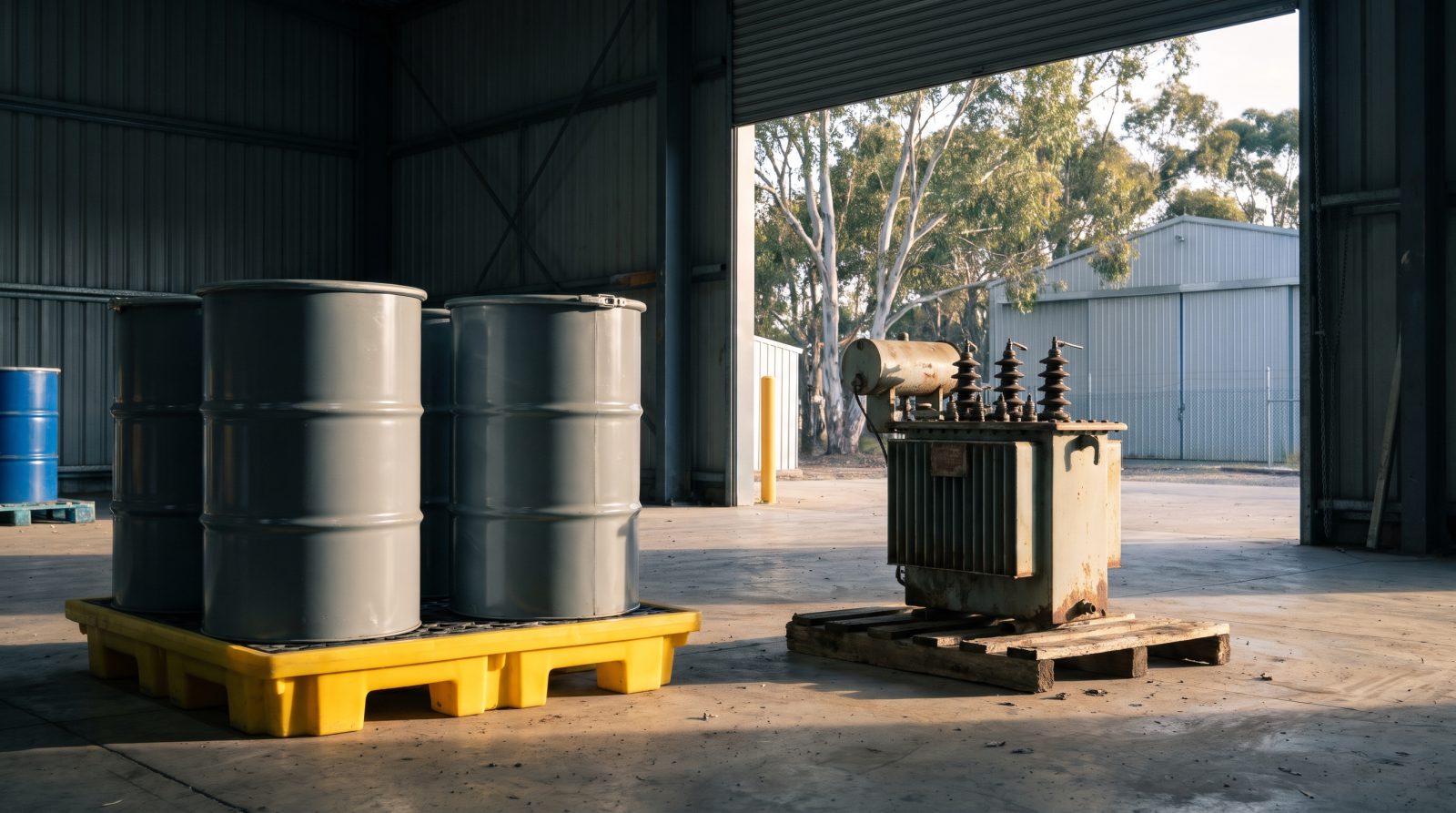
This guide is for electrical asset managers, plant managers and contractors who hold transformers, capacitors or oil that may contain polychlorinated biphenyls (PCBs). PCB waste regulations in Australia differ between states, so the steps for notifying the regulator, storing, moving and destroying PCB waste are not the same in Victoria, New South Wales and Queensland. Start by confirming the PCB concentration, then follow the rules of the state where the waste sits and the state it travels to.
Key takeaways
- In New South Wales, PCB waste means waste with more than 2 mg/kg of PCBs, and scheduled PCB waste is 50 mg/kg or more and 50 grams or more of PCBs.
- Victoria pre-classifies PCB-contaminated waste as reportable priority waste, and an environmentally hazardous substances order adds notification and consent steps.
- Queensland lists material containing PCBs as trackable regulated waste under waste code M100.
- Diluting PCB waste to change how it is classified is prohibited under the NSW PCB Chemical Control Order.
- Whoever consigns PCBs for destruction in Victoria must obtain a certificate of destruction or disposal from the receiving facility and keep it on record.
What counts as PCB waste?
PCB waste is any waste that contains PCBs above a set concentration, and scheduled PCB waste at 50 mg/kg or more carries more conditions. PCBs are stable chlorinated aromatic hydrocarbons that were widely used before 1980 as coolants and lubricants in electrical equipment, according to EPA Victoria. The Polychlorinated Biphenyl (PCB) Chemical Control Order 1997 in New South Wales sets out the definitions:
- PCB waste: waste containing PCBs at concentrations above 2 mg/kg.
- Non-scheduled PCB waste: PCB waste with a concentration below 50 mg/kg.
- Scheduled PCB waste: PCB waste at 50 mg/kg or greater, at 50 grams or greater of PCBs.
The result of a laboratory test decides which category applies, so a test report is the starting point for every decision that follows. Our guide on how to test transformer oil for PCBs explains the sampling step.
How does New South Wales regulate PCB waste?
New South Wales regulates PCB material and PCB waste through the PCB Chemical Control Order 1997, which prohibits manufacturing, keeping, conveying, selling or disposing of them unless the order permits it. The order sets these obligations for occupiers who hold scheduled PCB waste.
Notification and storage
The occupier must notify the NSW EPA in writing of the identity, amount and location of scheduled PCB material or waste within 30 days of the quantity on site becoming greater than 10 kg, and annually after that. Liquid scheduled PCB waste must be stored in line with Australian Standard AS 1940, and every package must be clearly marked and kept in good order. Where one tonne or more of scheduled PCB waste is kept, it must be held under the authority of a licence.
Treatment
Scheduled PCB waste may only be processed by an approved process under a licence. Any liquid residue from that processing must contain less than 2 mg/kg of PCB. The order also treats dilution, or separating mixed materials so that scheduled waste becomes non-scheduled, as prohibited acts.
How does Victoria regulate PCB waste?
Victoria pre-classifies waste contaminated with PCBs as reportable priority waste under Schedule 5 of the Environment Protection Regulations 2021, and an environmentally hazardous substances order applies on top of that classification. EPA Victoria's PCB guidance (updated 29 January 2026) sets out these steps:
- Notify EPA Victoria using the Notification: PCBs present form when material or waste contains over 10 kg of PCBs, or over 50 g of PCBs at a concentration above 50 mg/kg.
- Obtain EPA consent before PCBs are transported within Victoria, including transport for eventual transport out of Victoria, and before they are sold or supplied.
- Use a transporter with an A10b registration and a receiving facility with an A01 licence, because a permission is needed to transport, receive or store PCB waste.
- Obtain a Certificate of Destruction or Disposal of Polychlorinated Biphenyls from the receiving facility, make sure EPA Victoria receives a copy, and keep the certificate on record.
EPA notes that consent to sell or supply PCBs is not a permission; it is a requirement of the order.
How does Queensland regulate PCB waste?
Queensland treats material containing PCBs as regulated waste that must be tracked, under waste code M100. The list of trackable waste in Queensland takes its codes from Schedule 2E of the Environmental Protection Regulation 2019. Under that regulation, waste generators, waste transporters and waste receivers each have obligations when they handle regulated waste.
The licensed transporter raises the tracking record for each pickup and signs it off at pickup and at delivery. The generator should check that the waste code and the receiving facility are correct and keep a copy for its records. Our article on hazardous waste paperwork in VIC, NSW and QLD covers the tracking systems in more detail.
How do PCB waste regulations compare between states?
The three states share the same goal but use different instruments and triggers.
| Topic | New South Wales | Victoria | Queensland |
|---|---|---|---|
| Main instrument | PCB Chemical Control Order 1997 | Environment Protection Regulations 2021 and an environmentally hazardous substances order | Environmental Protection Regulation 2019 |
| Classification | PCB waste above 2 mg/kg; scheduled at 50 mg/kg and 50 g or more | Reportable priority waste | Trackable regulated waste, code M100 |
| Notification trigger | More than 10 kg of scheduled PCB material or waste kept on site | Over 10 kg of PCBs, or over 50 g at above 50 mg/kg | Waste tracking for each movement |
| Before transport | Conveying must meet the order's conditions | EPA consent plus a permitted transporter | A transporter that meets the tracking obligations |
What should a site do before PCB waste leaves?
A site should have a test result, the right notifications and a confirmed receiving facility before any PCB waste is collected. This checklist covers the common steps across all three states:
- Test the oil or material at a NATA-accredited laboratory and record the PCB concentration.
- Work out the quantity of PCB waste held and the mass of PCBs in it, since the notification triggers depend on both.
- Lodge the notification the state requires, within its time limit.
- Keep PCB waste in sound, clearly marked packages in a defined storage area, and never dilute it.
- Confirm the transporter and the receiving facility hold the permissions the state requires.
- Check the waste code and receiving facility on the tracking record before the truck leaves.
- File the certificate of destruction or disposal when it arrives.
Frequently asked questions
Is oil with less than 50 mg/kg of PCBs still PCB waste?
In New South Wales, waste above 2 mg/kg of PCBs is PCB waste, and waste below 50 mg/kg is non-scheduled PCB waste. Non-scheduled waste still falls under the PCB Chemical Control Order, but with fewer conditions than scheduled waste.
Can PCB oil be blended with clean oil to lower its concentration?
No. The NSW PCB Chemical Control Order treats dilution of PCB material or PCB waste as a prohibited act. Blending to help processing needs the prior written approval of the NSW EPA.
Who issues the certificate of destruction in Victoria?
The receiving facility issues a Certificate of Destruction or Disposal of Polychlorinated Biphenyls to the occupier who consigned the PCBs. The consignor must make sure EPA Victoria receives a copy, and both parties must keep records of the certificate.
What waste code applies to PCB waste in Queensland?
Material containing PCBs is listed under waste code M100 in the list of trackable waste in Queensland. The codes come from Schedule 2E of the Environmental Protection Regulation 2019.
Sources
- Polychlorinated biphenyls (PCBs), EPA Victoria, updated 29 January 2026.
- Polychlorinated Biphenyl (PCB) Chemical Control Order 1997, NSW EPA, commenced 21 July 1997.
- List of trackable waste in Queensland, Queensland Government, reviewed 12 June 2025.
- Waste tracking obligations, Queensland Government, updated 17 July 2026.
How Benzoil can help
Benzoil arranges PCB testing, collection, transport and destruction through licensed partners and NATA-accredited laboratories, in line with the rules of each state. We check the waste codes and receiving facility on the tracking paperwork, and you receive a copy. See our PCB oil disposal service for transformer decommissioning and oil recovery. Call 0497 645 008, email info@benzoil.com.au or request a quote. You can also contact Benzoil with your test results.


