
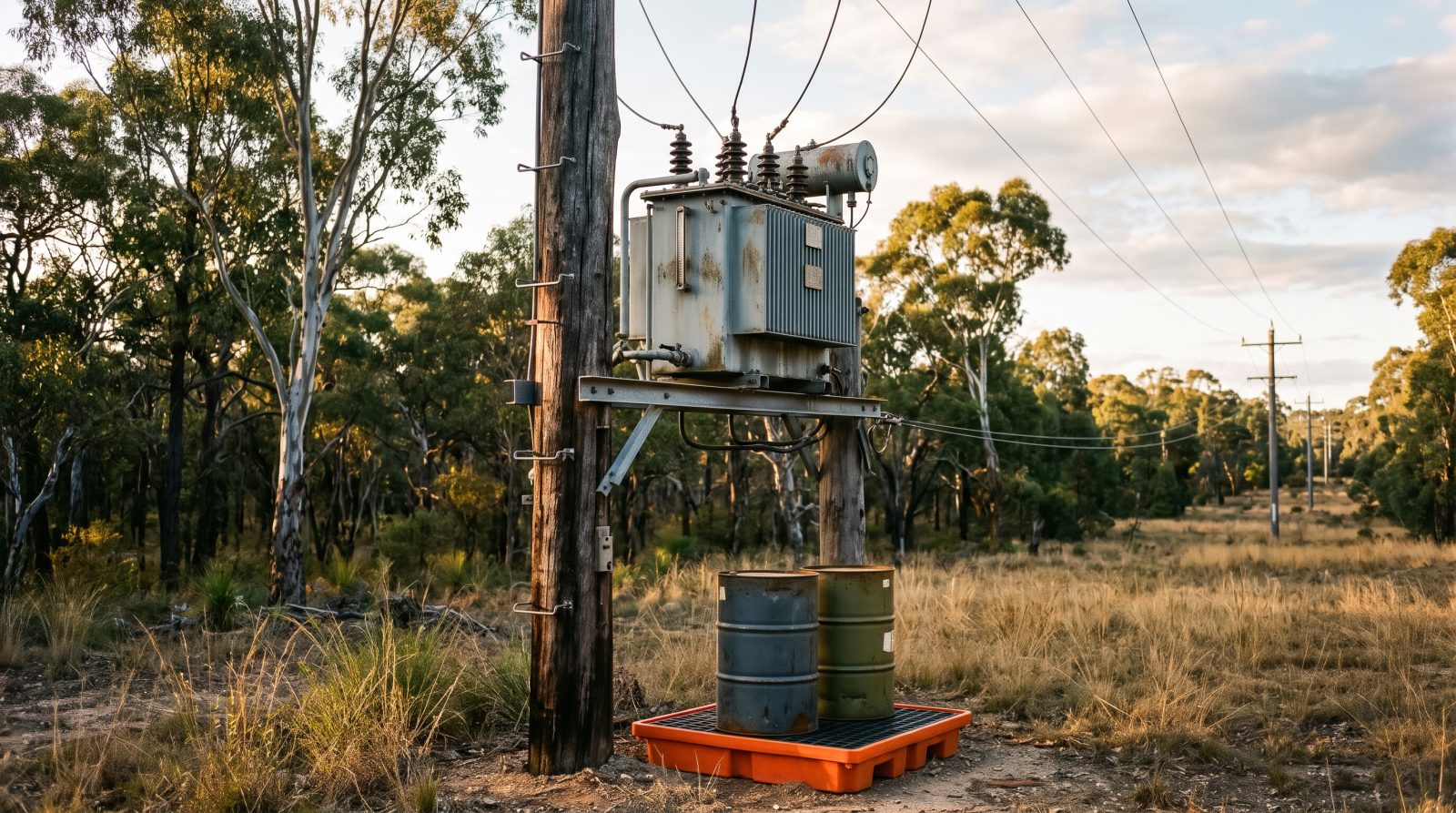
This guide is for electrical asset managers, maintenance contractors and environmental staff in Australia who buy, store or dispose of transformer oil. Is transformer oil hazardous? New mineral transformer oil is hard to ignite at room temperature and has limited acute health effects, but it is not harmless, and each product's hazards are set out in its safety data sheet. Once used, transformer oil becomes regulated waste, and oil contaminated with polychlorinated biphenyls (PCBs) carries its own waste codes and extra rules.
Key takeaways
- Mineral transformer oil has a high flash point, listed at about 146°C (295°F) in the CAMEO Chemicals datasheet published by the US National Oceanic and Atmospheric Administration.
- Manufacturers and importers of hazardous substances and dangerous goods must give users a current safety data sheet (SDS), which covers health effects, first aid, storage and disposal.
- In Victoria, used transformer fluid without PCBs is waste code J100, a reportable priority waste that is tracked each time it changes hands.
- Oil with more than 2 mg/kg of PCBs is waste code M120, and oil with 50 mg/kg or more is M100.
- EPA Victoria describes PCBs as probable human carcinogens.
Is transformer oil hazardous?
New mineral transformer oil carries limited hazards, while used oil and PCB-contaminated oil are regulated. The CAMEO Chemicals datasheet lists a high flash point for transformer oil and notes that swallowing it may irritate the stomach. The hazards of a specific product, and how to handle it, are set out in the supplier's SDS.
The question changes once the oil leaves service. Used oil is a waste, and in Victoria its PCB content decides which waste code applies. EPA Victoria classifies each of those codes as reportable priority waste, so the oil is tracked from the site to the receiving facility.
Is transformer oil flammable?
Mineral transformer oil is not easy to ignite, because its flash point is far above normal workplace temperatures. The flash point is the lowest temperature at which a liquid gives off enough vapour to ignite. The CAMEO Chemicals datasheet published by the US National Oceanic and Atmospheric Administration lists about 146°C (295°F) for transformer oil.
For comparison, SafeWork NSW explains that Category 4 flammable liquids are equivalent to C1 combustible liquids, with a flash point greater than 60°C and up to 93°C. The CAMEO figure for transformer oil sits well above that band. The oil can still burn once it is heated past its flash point.
Is transformer oil toxic to people?
New mineral transformer oil has limited acute effects, while PCBs are a serious long-term health hazard. The CAMEO Chemicals datasheet notes that swallowing transformer oil may irritate the stomach, and that if it is taken into the lungs, delayed pulmonary irritation may occur. Skin and eye effects, exposure limits and protective equipment for a specific product are listed in its SDS.
EPA Victoria states that PCBs are probable human carcinogens and that long-term exposure is linked to liver damage, skin issues and immune and nervous system problems. It also notes that PCBs were widely used as coolants and lubricants in electrical equipment. A laboratory test of the oil shows whether it falls under the PCB waste codes, and our guide to testing transformer oil for PCBs explains how sampling works.
What does the safety data sheet tell you?
The SDS sets out the health and safety information for a product, and WorkSafe Victoria explains who must provide it. Manufacturers and importers of hazardous substances and dangerous goods must give the current SDS to employers or occupiers of premises where the product is used or stored, and downstream suppliers must pass it on to buyers.
Employers must obtain an up-to-date SDS for each of these products and make it available to employees, contractors and emergency services personnel. WorkSafe Victoria lists what the SDS must contain, including toxicological information and health effects, first aid measures, handling and storage information, and disposal considerations.
A certificate of analysis is a separate document. It records the test results for a batch of oil against its specification, and our guide to reading a transformer oil certificate of analysis covers what each result means.
Is used transformer oil hazardous waste?
Yes. In Victoria, used transformer oil is a reportable priority waste. EPA Victoria's waste code list places waste oils, hydrocarbons, emulsions and transformer fluids excluding PCBs under code J100, classified as reportable priority waste.
PCB content changes the code. Oils contaminated with PCBs at more than 2 mg/kg and up to 50 mg/kg are code M120, and oils at 50 mg/kg or more are code M100. Both are reportable priority waste. EPA Victoria also lists notification triggers for PCBs, including more than 50 g of PCBs at a concentration above 50 mg/kg, or more than 10 kg of PCBs.
For reportable priority waste, EPA Victoria requires a permission to transport the waste and a Waste Tracker entry every time the waste changes hands. Queensland, New South Wales and Victoria each run their own tracking system, so the paperwork differs by state even when the oil is the same.
| Used oil | Victorian waste code | Classification |
|---|---|---|
| Waste oils and transformer fluids excluding PCBs | J100 | Reportable priority waste |
| Oils with PCBs above 2 mg/kg and up to 50 mg/kg | M120 | Reportable priority waste |
| Oils with PCBs at 50 mg/kg or more | M100 | Reportable priority waste |
Documents that go with transformer oil
- The current SDS for each oil product used or stored on site.
- The certificate of analysis for each supply of new oil.
- A laboratory PCB result for oil taken out of service.
- The waste transport certificate or tracking record for each pickup of used oil.
Frequently asked questions
Is transformer oil flammable?
Mineral transformer oil has a high flash point, listed at about 146°C in the CAMEO Chemicals datasheet. That is well above the band of 60°C to 93°C for Category 4 flammable liquids. It can still burn once heated past its flash point.
Is transformer oil toxic?
New mineral transformer oil has limited acute effects: swallowing it may irritate the stomach, and oil taken into the lungs may cause delayed irritation. PCB-contaminated oil is more serious, because EPA Victoria describes PCBs as probable human carcinogens. The product's SDS lists its exposure and first aid details.
Is used transformer oil hazardous waste?
Yes. In Victoria, used transformer fluid without PCBs is code J100, a reportable priority waste. Oil with more than 2 mg/kg of PCBs is code M120 or M100, depending on the concentration.
Who must provide the safety data sheet for transformer oil?
For hazardous substances and dangerous goods, the manufacturer or importer must give the current SDS to the business that uses or stores the product, and downstream suppliers must pass it on. The employer must make it available to workers, contractors and emergency services.
Sources
- Oil, transformer: chemical datasheet, CAMEO Chemicals, US National Oceanic and Atmospheric Administration, flash point data from USCG 1999.
- Placarding for storage of hazardous chemicals, SafeWork NSW, accessed 25 November 2026.
- Safety data sheets, WorkSafe Victoria, reviewed 23 November 2026.
- Waste codes, publication 822.5, EPA Victoria, September 2024.
- Waste codes, EPA Victoria, updated 21 May 2025.
- Polychlorinated biphenyls (PCBs), EPA Victoria, updated 29 January 2026.
How Benzoil can help
Benzoil supplies inhibited mineral insulating oil conforming to IEC 60296 and AS 60296 for power and distribution transformers, PCB-free, with a NATA-accredited certificate of analysis for every supply. Oil is delivered nationwide in 20L containers, 205L drums and 1,000L IBCs, and our transformer oil supply page covers the full range. When oil comes out of service, Benzoil arranges PCB testing, collection and treatment through licensed partners and NATA-accredited laboratories. Call 0497 645 008, email info@benzoil.com.au or request a quote, or reach us through our contact page.


